



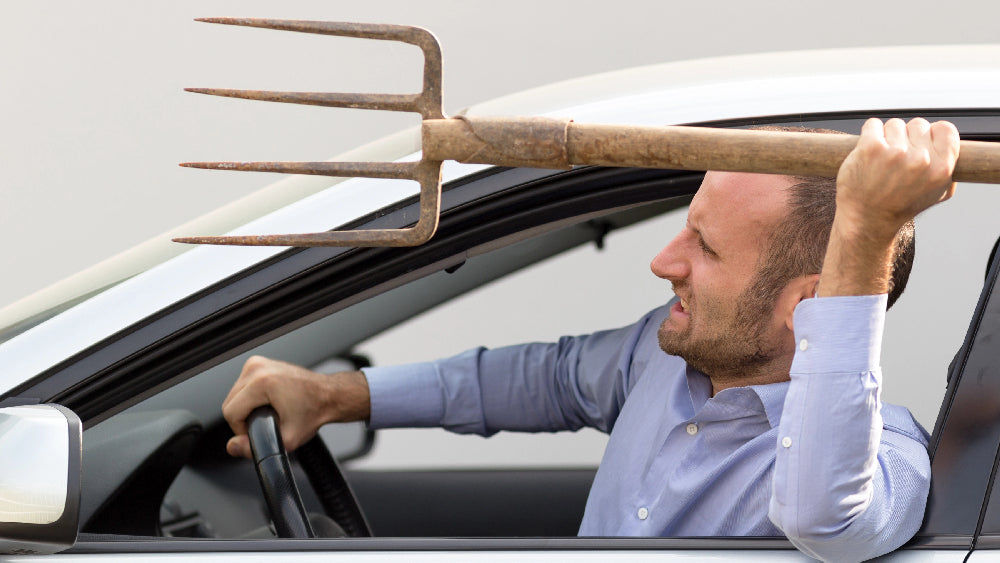
Road Rage Isn't Always About Anger. Sometimes It's About Being Blind
There's a moment every commuter knows.
You're running a few minutes late, traffic is moving (barely) and the car in front of you suddenly slams on the brakes. No accident ahead. No pedestrian. No red light. Just a panic stop out of nowhere, and you have about a half-second to keep from rear-ending them.
If you're lucky, you stop in time. Your heart's pounding. Maybe you lean on the horn. Maybe you say some things you wouldn't repeat in polite company. But there's a chance that driver wasn't distracted, wasn't texting, and wasn't having a bad day. There's a good chance they couldn't see. And if you'd been 30 feet further ahead, in the same spot, you might have done the exact same thing.
Sun glare doesn't just cause accidents. It causes unpredictable and seemingly inexplicable behavior that makes the other drivers on the road angry. That anger leads to a whole separate chain of dangerous decisions.
The Invisible Trigger Nobody Talks About
We talk about road rage as though it's a personality problem. The aggressive driver who tailgates, the guy who cuts you off and then gives you the look, the person weaving through traffic like it's a personal competition. Yes, some of that is temperament.
Research from the American Psychological Association confirms that environmental factors like crowded roads and high traffic density genuinely increase aggressive driving behavior, and you're not imagining it.
But here's what doesn't get attention: a lot of behaviors that trigger road rage in other drivers aren't aggression at all. It's panic. It's confusion. It's a driver who just got hit with blinding sun glare mid-turn and did the only thing they could. They stopped, or swerved, or slammed the brakes, and now everyone behind them is angry.
I've watched this play out many times on my commute. There's a stretch of highway heading east where the sun sits just above the horizon during the morning rush. For a few weeks every spring and fall, when you come over the top of a rise, the glare is so sudden and so complete that it's like someone turned off the road.
I've seen drivers come over that rise and panic-stop right there on the highway. It only takes one. The car behind them brakes hard. The car behind that one doesn't have time. Now there's a pileup (or near-pileup) that backs up traffic for a mile, and everyone arriving at the back of that jam has no idea why they're sitting still.
The drivers who stopped weren't aggressive, they were blind.
How Glare Turns Good Drivers Into Bad Ones
Sun glare is the second-highest environmental cause of serious accidents, right behind slick roads, according to the National Highway Traffic Safety Administration. It contributes to roughly 9,000 crashes every year in the U.S. alone. What those statistics don't fully capture is the ripple effect: the chain of reactions that starts with one blinded driver and ends with multiple cars involved. Now there are more frustrated drivers, and everyone is on edge for the rest of the commute.
Here's what happens physiologically when a driver hits sudden intense glare. The sun goes from tolerable to blinding in seconds, especially if you make a turn, and the angle shifts completely. The pupil can't react fast enough. Vision whites out. According to research published by the National Library of Medicine, the risk of a life-threatening crash is 16% higher during bright sunlight than in normal conditions for the glare-affected driver. It doesn't count what happens to the drivers around them.
If the driver panics or overcompensates after a brief period of impaired vision (braking too hard, drifting, or suddenly slowing). The result is the kind of move that makes everyone else furious. The car behind them doesn't know there was a blinding patch of glare. They just see brake lights with no warning, and their brain immediately writes a story: that person is a bad driver.
The frustration is understandable. But it's often misplaced.
The Cascade Effect
How does this actually unfold? I bet most of us have lived through it, but didn't connect the dots.
Driver A hits glare, panic-brakes.
Driver B, right behind, has to brake hard too, and stops in time, but with a surge of adrenaline and frustration.
Driver B is now tailgating Driver A, convinced they're incompetent.
Driver C, watching all of this, changes lanes abruptly to get away from the situation.
Driver D, in the lane Driver C just moved into, is cut off without warning and hits their horn.
Driver D is now angry. Driver B is angry. Driver C is scared. And we're just seconds into a commute that was fine just a moment ago.
None of this started with a bad driver. It started with a patch of light.
Research on road rage confirms that stress in congested or high-frustration driving environments can lead to displaced anger. Where frustration from one source gets directed at whoever is most convenient. A driver who's been sitting in stop-and-go traffic for 20 minutes is already primed for aggression. The next driver who cuts them off gets hit with the full force.
The "Duck-and-Flip" Factor
Another part of this that doesn't get enough attention? The moment when a driver is dealing with glare isn't just dangerous for them. It's unpredictable for everyone around them.
Most drivers handle sun glare by reaching up and swinging the car's sun visor, what we call the "duck-and-flip." To do it, you have to dip your head, briefly look away from the road, find the visor, and swing it into position. It takes only a second but that's a second where the car may drift slightly, where braking is delayed, where your eyes aren't on the road.
To the driver in the next lane, that tiny drift looks like inattention, or worse, aggression. To the driver behind, the slight hesitation in braking looks like erratic behavior. Neither one knows there was a visor involved. They see something strange happen, and they react.
This is one of the quieter ways that glare contributes to driver stress on the road. It's not only the blinded driver who's affected. It's everyone who has to adjust for them.
What You Can Actually Do About It
The good news is that, unlike many driving hazards, this one is manageable. Managing it protects you, and it protects the drivers around you from the cascade effect described above.
1. Prepare before you move. This is the single most effective thing. Before you pull out of the driveway, position your visor for the route you're about to drive. If you're heading east in the morning, get the visor down before you need it. The duck-and-flip happens because drivers wait until they're blinded to act, and by then it's too late to do it smoothly.
2. Maintain extra following distance in known glare conditions. If you know your commute has a glare-heavy stretch (say, heading east in the morning, west in the evening) leave more room. You need space to react both to your own sudden impaired vision and to the panic response of the car ahead of you.
3. Add glare protection from multiple directions. The standard car visor only covers one direction at a time. When you turn, the glare shifts, and the visor doesn't come with you. That's exactly the moment when you need protection most: turning at an intersection when your attention has to be everywhere at once.
The ADDVISOR was designed for this. It mounts independently from the regular visor, giving you a 2nd visor. You have two directions covered, at the same time, without a duck-and-flip in sight.
4. Recognize glare behavior in other drivers before you react. This one is mostly mental, but it matters. The next time a car ahead of you does something that seems stupid or erratic (a sudden slow-down, an unexplained drift, a late brake) ask yourself whether glare could be the cause before you decide the driver is an idiot. Maybe they're dealing with something you can't see. Give them a little room, literally and mentally.
5. Keep your windshield clean, inside and out. A dirty windshield reduces visibility on its own, it also amplifies glare dramatically. Dirt, dust, and the invisible film that builds up on the interior glass scatter incoming light in every direction, turning manageable glare into a whiteout. In simulator studies Monash University's Accident Research Centre found that dirty windshields cause drivers to crash twice as often. That's 100% more often than in normal conditions. Two minutes with a microfiber cloth can make a meaningful difference.
A Little Patience Goes a Long Way
I'm not here to tell anyone to be saintly about bad driving. Thirty-plus years of commuting has given me more than enough legitimate grievances. Some drivers are reckless. Some are distracted. The tailgaters and the lane-drifters and the phone-in-hand crowd deserve every bit of frustration they generate.
But some moments that spike our blood pressure on the road (the sudden stops, the hesitation, the inexplicable slow-downs) aren't malice or carelessness. They're someone dealing with a visibility problem they weren't prepared for. Understanding that doesn't make it less dangerous. But it changes how you respond, and that response is the one thing you can actually control.
The safest driver isn't the fastest one or the most assertive one. It's the one who can read what's happening around them accurately. That means knowing that the car that slammed on the brakes might not be the problem. The sun might be.
Stay calm, stay prepared, and as always:
Enjoy the Drive!
SmartAdditions Inc. was founded in 2022 with a mission to provide high-quality automotive accessories that improve safety, comfort, and convenience while driving. Our flagship product, The ADDVISOR, is the Original Independent Sun Visor offering Two-Direction Sun Protection™ that fits nearly all cars, trucks, and SUVs. SmartAdditions is an owner-operated small business, created by Danny and Greg, and proudly located in the Hudson Valley Region of New York state.



Leave a comment
All comments are moderated before being published.
This site is protected by hCaptcha and the hCaptcha Privacy Policy and Terms of Service apply.